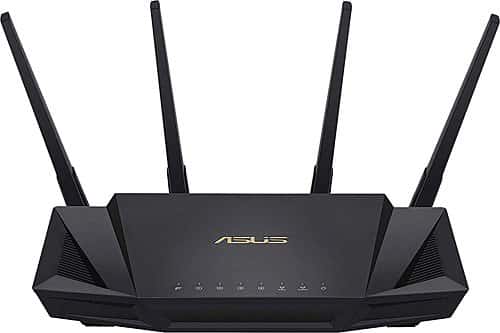
The Asus RT-AX58U is a dual-band router built on the 802.11ax standard, better known as Wi-Fi 6. This review covers the RT-AX58U’s design, its Wi-Fi 6 performance and rated speeds, its AiMesh coverage, and what desktop users need to run it at full speed.
Wi-Fi 6 is the latest step in a standard that has evolved steadily since the first 802.11 version, which reached about 2 Mbit per second. The RT-AX58U is one of Asus’s routers built around it.
Design
The RT-AX58U has a broad, substantial body with four large external antennas that dominate the look of the unit. The build feels solid at first glance.
Performance & Range
The RT-AX58U is a dual-band Wi-Fi 6 router. It supports 160 MHz channel width and 1024-QAM modulation. On the 2.4 GHz band it is rated at 574 Mbps, and on the 5 GHz band at 2402 Mbps, for a combined theoretical rate of about 3000 Mbps. These figures are theoretical maximums.
Wi-Fi 6 speeds require Wi-Fi 6 client devices, that is, a phone or computer that also supports the standard. With older hardware, the RT-AX58U falls back to Wi-Fi 5 (802.11ac), which still carries high data rates.
The router works with Asus’s AiMesh system. AiMesh links multiple Asus routers into a single network to extend coverage, which helps in larger or multi-story homes and in spots where one router leaves range gaps. As more devices in a home stay connected at once, from smart-home gear onward, that wider coverage matters more.
Setup
Desktops usually lack built-in Wi-Fi 6. To use the standard on a desktop, users pair the RT-AX58U with a compatible adapter such as the Asus PCE-AX58BT, which installs in a PCI-E slot. After the card is fitted and its antennas are connected, the adapter and router communicate over Wi-Fi 6. The PCE-AX58BT also includes Bluetooth 5.
This pairing matters most for competitive gaming, where low latency counts, and for high-bitrate streaming.
Who Is Asus RT-AX58U For?
The Asus RT-AX58U fits users moving to Wi-Fi 6 who have a fast internet connection and many devices connected at once, with competitive online gaming, video streaming, and cloud uploads among the demanding cases. Its AiMesh support suits homes with coverage gaps. Users on older Wi-Fi 5 devices with light everyday needs will not see the Wi-Fi 6 gains, and a simpler router serves those uses well.
Related reading: our TP-Link Archer VR2100 review.
Bu incelemeyi nasıl hazırladık?
Teknik değerleri güvenilir kaynaktan alır, kendi sözümüzle kurar, kaynağını gösteririz. Ölçülmüş bağımsız test emeğini kendimize mal etmeyiz. Puan vermedik: kanaat, sıralama değil.
İşine uyanı gördüysen, gerisini merak etme — en pahalı değil, sana denk geleni almak en rahatı; kararın da, paran da bereketli olsun.
Okuyucu deneyimleri & sorular
Bu ürünü gerçekten kullananların notları — çoğu zaman incelememizden daha kıymetli. Puan/beğeni yok; işaret güven içindir: neyin faydalı, neyin şüpheli olduğunu topluluk gösterir.
Katkı için yola katıl.
Deneyimini paylaşmak ya da bir soru sormak için üye ol; okumak herkese açık. Emeğin kayıt altında, kıymeti kazanılır.